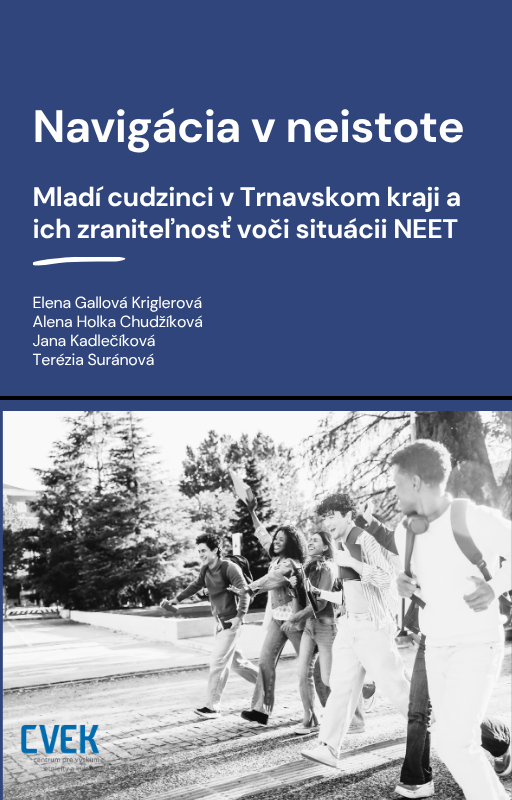
Navigating Uncertainty: Young Migrants in the Trnava Region and Their Vulnerability to NEET Status
A new research analysis, developed in partnership with the Regional Innovation and Development Agency (KIRA) of the Trnava Self-Governing Region, provides an in-depth look into the life trajectories, barriers, and needs of young people, with a dedicated focus on migrant and refugee youth across the region.
The transition from education to the labour market has become increasingly challenging for young people today. For migrant youth, however, this journey is an even more complex labyrinth. The lack of local social capital, language barriers, existential instability, and the trauma of war significantly heighten the risk of these individuals slipping through the cracks of existing support systems.
This analysis maps key facets of life for young migrants in the Trnava Region—ranging from initial school integration to their often precarious entry into the workforce. Anchored in the NEET framework (youth Not in Education, Employment, or Training), the research does more than simply diagnose a critical issue: it serves as a strategic foundation for essential institutional reform within the region. A cornerstone of this approach is the upcoming “One-Stop Shop” model for youth under 30.
The publication provides valuable insights for public administration officials, local government representatives, youth policymakers, NGO youth workers, and educators. Beyond analytical depth, it delivers actionable, practice-oriented recommendations aimed at building a more cohesive, equitable, and economically resilient community across our regions.
The analysis was published as part of the project “Perspectives and Potential of Young Migrants – Developing an Inclusive Support System,” funded by the European Union through the Impact Lab programme of the Pontis Foundation.


etnicity a kultúry
811 08 Bratislava
e-mail: info@cvek.sk
© 2026 CVEK created by volar.name graphic by Jakub Švrček