Publications

Youth and extremism. Factors influencing the radicalisation of young people and their perception of its manifestations
The publication Youth and Extremism is published within the framework of the project Radicalisation Prevention Mechanism – Police and Youth Together. It aims to contribute to effective youth radicalisation prevention policies.
As we consider it important that young people’s voices are heard in the processes of developing various prevention policies, we decided to involve them in the whole process of developing the prevention mechanism. We want to build on their views, needs and respond to the current problems of young people that can potentially lead to support for extremist groups or radicalisation.
The research consisted of two parts – quantitative questionnaire research and focus groups. The representative questionnaire research focused on different areas and factors that may underlie extremism and radicalisation. The research respondents were 1,005 young people aged 16-25, with the sample being representative in terms of gender, regional distribution, the size of the settlement where the young people live and other socio-demographic characteristics.
Based on initial findings from the quantitative research, we conducted seven focus groups with young people from different regions and backgrounds in early 2022. The sample included active young people involved in various participatory processes, as well as young people attending various low-threshold facilities. There were students from high schools, but also from vocational high schools and a university, in order to cover as diverse a range of young people’s views and needs as possible. In total, 43 young people participated in the focus groups.
Both quantitative and qualitative research focused on different areas of inquiry: young people’s perceptions of diversity in society, social capital and social problems, trust in institutions, trust in different sources of information, and perceptions of extremism and its various manifestations.
This publication is published as part of the project ‘Mechanism for Preventing Radicalisation and Extremism-Police and Youth Together’, which is supported by the ACF-Slovakia programme, funded by the EEA Financial Mechanism 2014-2021. The programme is administered by the Ekopolis Foundation in partnership with the Open Society Foundation Bratislava and the Carpathian Foundation.


Slovakia and Migration. Finding Pathways to Coexistence. Summary
The book brings interesting findings allow us to see coexistence in diverse society from both expert and humane point of view. It is a result of a two year long research project focused on integration of foreigners in Slovakia. The project entailed two representative quantitative surveys (among foreigners and majority population), one questionnaire survey among municipal offices of district capitals, 58 individual interviews with local leve integration actors, 9 focus groups with majority population and 50 individual interviews with foreigners living in Slovakia.
This research mosaic thus explores integration of foreigners comprehensively from different perspectives. It shows that public institutions are not ready to actively work towards integration of foreigners. Migrants remain invisible for public policies. Majority population sees migration as a threat rather than an opportunity. Contacts with foreigners, however, help change these attitudes to a great extent and contribute to peaceful coexistence. For foreigners, Slovakia is a nice and peaceful country offering opportunities to live a good life. It has potential to grow which is, however, hampered by our closemindedness towards diversity.
The project “Integration of foreigners – researching barriers, instruments and attitudes is co-funded by the European Union from the Asylum, Migration and Integration Fund. Internal Security Fund.


Information for those helping people from Ukraine
Many people in Slovakia today are helping people fleeing the war in Ukraine in various ways – whether as volunteers, providing accommodation or otherwise coming into contact with them. This help deserves great admiration. However, it can also be challenging. That’s why CVEK, in cooperation with the Milan Šimečka Foundation, has prepared a basic package of information for those who are helping people fleeing Ukraine in any way, so that they know what to expect from the situation and are able to cope with it together with the refugees, and also so that they can direct them when they need practical information. In this newsletter you will therefore find information on what refugees are experiencing, how it manifests itself and how to cope with it. But you will also find practical information on how to help them with things like cash withdrawals, sim card arrangements and temporary online education for their children.

Refugee children in schools – first steps and principles
Refugee children, who may already be starting to attend Slovak schools, find themselves in a situation they never knew could happen just a few days or weeks ago. They have had to leave their home from one day to the next and find themselves in a country that many of them have never even heard of. They may be experiencing trauma and be under a great deal of stress from having left their homes so quickly. We have prepared some principles and recommendations for schools on how to deal with this situation, at least in the beginning.
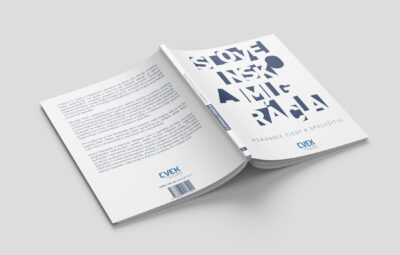
Slovakia and migration. Searching for ways to coexistence
The book “Slovakia and Migration. Searching for Ways to Coexistence” brings a number of interesting research findings that allow us to look at coexistence in a diverse society both professionally and humanly. The publication is the result of a two-year research project on the integration of foreigners in Slovakia, in which we conducted 2 representative quantitative surveys (among foreigners and the majority population), 1 questionnaire survey at the level of district towns, 56 individual interviews with integration actors at the local level, 9 focus groups with the majority population and 50 individual interviews with foreigners living in Slovakia.
This mosaic of research thus looks at the topic of inclusion of foreigners comprehensively from different perspectives. In the publication we point out that public administration institutions are still not prepared for the topic of integration. People with a migration background are invisible in public policies. Migration is resisted by the public and seen more as a threat than an opportunity. Mutual contacts with foreigners, however, greatly contribute to changing attitudes and better coexistence. For foreigners, Slovakia is a small and peaceful country where a good life can be lived. We have the potential to develop, but we are prevented from doing so by our closed attitude to diversity.
The book offers suggestions for improving public policies and promoting coexistence. Thus, policy makers, academics, other actors, and ordinary people interested in the kind of country we live in will find useful information in it.
The publication is an output of the project Research on the Integration of Foreigners – Barriers, Tools and Attitudes, which is co-financed by the European Union from the Asylum, Migration and Integration Fund. Funds for Home Affairs.

Civil society monitoring report on implementation of the national Roma integration strategy in Slovakia: Assessing the progress in four key policy areas of the strategy
This report was prepared by a consortium of seven Roma and pro-Roma NGOs under the leadership of CVEK. The report welcomes the willingness of state authorities to adopt systemic legislative and policy measures with the potential to facilitate inclusion of disadvantaged Roma, including a new bankruptcy regulation, new regulations simplifying legalisation of parcels underneath Roma settlements, or the introduction of free universal lunch for children in their final preschool year in kindergarten and through elementary school. However, the report raises concerns that especially in housing and education, at best, there are efforts to improve living standards and education through housing and schools for Roma. Both residential segregation and various forms of segregation of Roma children experienced from early age until their secondary school studies remain the practices most ignored by state authorities. Furthermore, as illustrated through cases of poor school attendance among disadvantaged students and workfare programmes, state authorities should focus on addressing the complex social and structural causes of problems rather than blaming and sanctioning those with few opportunities to help themselves, thereby reinforcing their exclusion trap. Finally, the design of policies, monitoring and evaluation, and data collection all require the adoption of an intersectional perspective considering the particularly vulnerable situation of Roma women and children.

Civil Society Monitoring Report on Implementation of the National Roma Integration Strategy in Slovakia
The monitoring report focuses on the structural and horizontal preconditions for the successful implementation of national integration strategy in Slovakia: governance and overall policy framework, fighting discrimination, addressing antigypsyism and education. The report also includes case studies of two localities to illustrate the potential and limits of Slovakia’s Roma inclusion policies in practice.
The report notes that despite relatively slow progress overall, we can trace palpable results, mostly through several active municipalities and through the projects of NGOs. Additionally, at least in areas such as housing, health and employment, we can see the efforts of the action plans of the NRIS to scale up successful local municipal or NGO-run projects using ESIF funds. As we argue throughout the report, nevertheless, significant efforts must be invested into actual implementation of plans into practice in all areas. Moreover, in the area of non-discrimination, especially when it comes to maltreatment by police, residential segregation and segregation in education, there appears to be limits even in the state recognition of troubling practices as a precondition for any meaningful action.
The report has been prepared by the Centre for the Research of Ethnicity and Culture (Governance and Overall Policy Framework, Antidiscrimination, Education), the Roma Advocacy and Research Centre (Antigypsyism), the Community Centre of Minorities (Case study of Veľký Krtíš), Roma Media – ROMED (Case study of Hlinné), the Association for Culture, Education and Communication, People in Need and Roma Platform.
The report has been prepared as part of the Roma Civil Monitor pilot project, ‘Capacity-building for Roma civil society and strengthening its involvement in the monitoring of National Roma Integration Strategies’. The pilot project is carried out for the European Commission, DG Justice and Consumers. It is coordinated by the Center for Policy Studies of Central European University (CEU CPS), in partnership with the European Roma Grassroots Organisations Network (ERGO Network), the European Roma Rights Centre (ERRC), the Fundación Secretariado Gitano (FSG) and the Roma Education Fund (REF) and implemented with around 90 NGOs and experts from up to 27 member states.

Victims of labour exploitation or “illegal” migrants? Ukrainian workers’ labour rights protection in Slovakia
The present report intends to shed some light on the practices of employing Ukrainian nationals in Slovakia in the recent period of 2013-2017. Attention is focused on emerging trends and employment patterns among Ukrainians working in low skilled professions. The report is based on desk research using existing studies and statistical data, plus qualitative interviews conducted with Ukrainian nationals living in Slovakia, with a representative of the labour inspectorate, the National Union of Employers, Employment Institute, the Institute of Economic and Social Studies and an intergovernmental organization providing support services to migrants.
The research, as well as previous work in the field of violations of migrant workers’ labour rights, points to exploitation as an understated yet widespread issue in Slovakia. The report uses the concept of labour exploitation as defined by the EU Agency for Fundamental Rights (FRA). According to FRA3, at least four aspects need to be taken into consideration when speaking about labour exploitation of migrant workers:
1. social policies
2. freedom of movement
3. migration policies
4. criminal justice and the rights of victims of crime

A baedeker from Foreigners to Foreigner in Arabic
The idea for the project Intercultural Guide to Lives in Slovakia came from the constantly recurring questions concerning daily life in Slovakia which we are asked during our work by incoming foreigners. The great number of them surprised us at first, we still do not have an answer to some, and it is evident that for many questions no simple answers exist.
Our idea was a book that looks different to the ordinary guidebook for a country. So then, do not look into it for facts about the country’s area, the number of inhabitants, or precise instructions on what you may and may not do. Our guide, by taking the qualities or strangenesses of Slovakia as perceived by people from outside, aims to enable new arrivals and old-established residents alike to look at ordinary situations from different perspectives and to taste, with a pinch of spice and salt, what we’re cooking together.

A baedeker from Foreigners to Foreigner in Russian
The idea for the project Intercultural Guide to Lives in Slovakia came from the constantly recurring questions concerning daily life in Slovakia which we are asked during our work by incoming foreigners. The great number of them surprised us at first, we still do not have an answer to some, and it is evident that for many questions no simple answers exist.
Our idea was a book that looks different to the ordinary guidebook for a country. So then, do not look into it for facts about the country’s area, the number of inhabitants, or precise instructions on what you may and may not do. Our guide, by taking the qualities or strangenesses of Slovakia as perceived by people from outside, aims to enable new arrivals and old-established residents alike to look at ordinary situations from different perspectives and to taste, with a pinch of spice and salt, what we’re cooking together.


etnicity a kultúry
811 08 Bratislava
e-mail: info@cvek.sk
© 2026 CVEK created by volar.name graphic by Jakub Švrček